- Specialization
- Data Engineering
- Business
- Software Applications
- Market
- Cross Industry
- Ecosystem
- Not classified
- Customers
- Enterprises
More details
- Organization type
- Commercial Company
- Ecosystem
- Not classified
- Business
- Software Applications
- Specialization
- Data Engineering
- Market
- Cross Industry
- Customers
- Enterprises
- Delivery models
- Hosted Software
- Revenue models
- Usage Based
- Listing status
- Not classified
- Latest equity round
- Series E Plus
- Reported funding amount
- $200M-$1B
About
Cribl builds a vendor-agnostic telemetry platform for enterprise IT and security teams, covering collection, management, investigation, search, and analysis across observability data. Its differentiation is portability and customer control: the platform works across sources and destinations without lock-in or data loss, serving organizations including approximately half of Fortune 100 companies.
Market
Cribl competes in the observability and telemetry-pipeline market, serving as a vendor-neutral data-management layer for collecting, filtering, enriching, routing, storing, and searching IT and security telemetry before it reaches analytics, SIEM, or data-lake systems. Its differentiation is an open, multi-destination architecture designed to reduce ingestion and storage costs while avoiding vendor lock-in, increasingly augmented with AI-assisted search, parsing, investigation, and security-operations capabilities.
Cribl primarily targets large enterprises with complex, high-volume IT and security telemetry environments, including regulated and multi-cloud organizations. Its key buyers and users are IT operations, security operations/SOC, observability, SRE, and data-platform teams seeking control over telemetry costs, routing, storage, and analysis.
At a Glance
Problem
Modern enterprises generate rapidly expanding volumes of logs, metrics, traces, and security data, but conventional observability architectures often require teams to ingest, store, and pay to analyze everything. This creates a costly trade-off between broad visibility and controlling infrastructure and licensing spend, while also creating dependence on particular data stores or observability vendors. Cribl addresses this problem by helping organizations decide what data to retain, where to send it, and how to make it usable across systems.
The main use case is routing and preparing telemetry for the tools that need it—especially observability platforms, SIEMs, and UEBA systems—without forcing every event through an expensive destination. This supports faster troubleshooting and security investigations while reducing unnecessary ingestion and storage costs.
Product / Service
Cribl is positioned as an open, vendor-agnostic telemetry platform built around products including Cribl Stream, Cribl Edge, and Cribl Search. Stream processes data in flight, Edge handles data at the edge, and the platform can route, transform, and deliver IT and security data to different systems, databases, and data stores. Cribl Search adds federated “search-in-place” capability, allowing users to query data where it already resides rather than first shipping, ingesting, and storing it in a central repository.
The resulting benefit is choice and control: customers can use their existing observability and security investments, enrich or process data before delivery, and investigate more sources without accepting additional lock-in or the cost of centralizing everything. The model is therefore complementary to existing systems as well as an alternative to architectures that require a single vendor to collect and retain all telemetry.
Market
Cribl competes in the observability, telemetry data-management, and IT and security data-orchestration market, with an expanding position around open observability and search. Its practical competitive set includes incumbent observability platforms, centralized log-search products, SIEM and UEBA stacks, and other tools that collect, store, or route telemetry; the available research refers to rival observability tools but does not identify specific competitors by name.
Cribl is clearly post-revenue and has substantial enterprise traction rather than being pre-revenue. An August 2024 report said the company had raised $319 million in Series E funding at a $3.5 billion valuation and had reported $100 million in annual recurring revenue; Cribl also says it is trusted by organizations including half of the Fortune 100. Its current positioning extends the company from observability data routing toward an AI-era telemetry infrastructure platform for enterprise copilots, agents, and investigations.
Founders & Leadership
Funding History
Undisclosed in available evidence
Sequoia Capital
Greylock, Redpoint Ventures
Tiger Global Management
GV (Google Ventures)
Undisclosed in available evidence
Recent News
Cribl announced the winners of its first Cribl GOAT Customer Awards at CriblCon 2026, recognizing customers and partners for their use of Cribl. Winners included Moody’s, ServiceNow, Prudential Financial, the University of Nebraska, and Blackwood Associates.
Cribl announced StreamAI, an enterprise AI gateway with a model router built into its open data platform. The company said the router helps organizations manage AI traffic, token usage, costs, and risk.
Cribl announced Cribl Detect, a security information and event management (SIEM) offering built on its open data platform. The company said it gives security teams tools to detect, investigate, and respond to threats, with a platform-first approach that supports customization.
Cribl introduced its Guard Privacy 3.0 model family, adding thresholds tailored to each type of sensitive information and a new Pro model for deeper detection. The company said the updated tiers improve detection precision and provide options for different workload needs.
Cribl announced backend functions for Cribl Apps in its 4.20 release and said Apps moved to general availability. The functions let developers expose HTTP endpoints and run scheduled jobs, enabling app workflows to operate in the background.
Cribl announced that it acquired technology assets from Radiant Security’s AI-native security operations center product. The acquisition adds intellectual property for autonomously triaging, investigating, and resolving security alerts, which Cribl plans to run as an application on its telemetry data platform.
Cribl announced that Cribl Stream integrates with the Claude Compliance API, providing essential visibility for Claude Enterprise.
Cribl introduced background detection for Cribl Guard, an AI-driven capability that continuously scans in-flight logs, traces, and events to uncover hidden sensitive data.
Cribl announced its recognition in Wiz’s inaugural WIN Partner Index 2025 as one of the most popular integrations in the Wiz Integration Network.
Cribl unveiled Guard as a proactive, AI-driven solution for detecting and protecting sensitive information in telemetry data in real time. Its initial release included more than 200 customizable rules and automated masking or blocking before storage.
Active Roles
68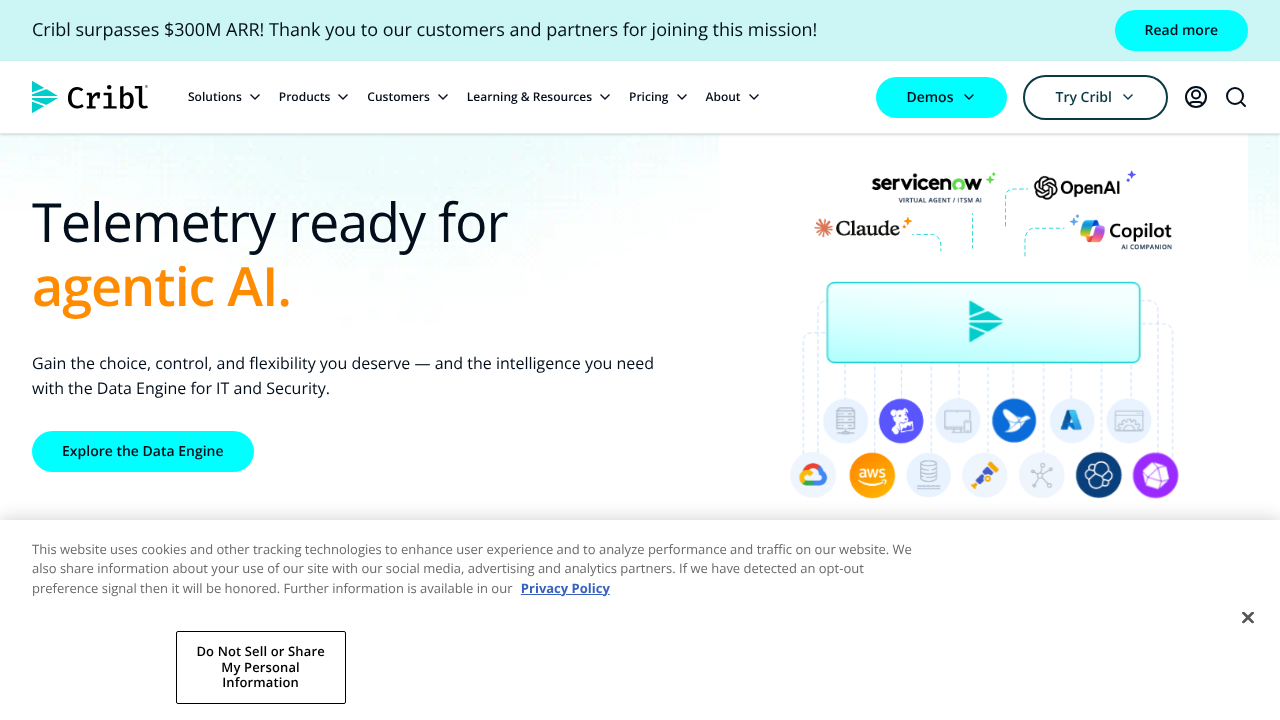
Business Model
Cribl monetizes its telemetry software and cloud product suite through flexible, usage- or consumption-based pricing: customers pay for what they use and can choose Free, Standard, or Enterprise editions. Recurring revenue comes from products including Stream, Edge, Search, and Lake, with cloud offerings contributing substantially to ARR.
Products
Customers
Tech Stack
Similar Companies
Competitors
Key Investors
GV (Google Ventures); GIC; CapitalG; IVP; CRV; Greylock; Redpoint Ventures